

US Stocks and Bitcoin Are Falling US Stocks and Bitcoin Are Falling
📉 Why US Stocks and Bitcoin Are Falling in 2026: A Liquidity Crisis in the Making?
The recent decline in US stocks and Bitcoin has left investors divided. Some believe the Federal Reserve will once again step in with aggressive liquidity support. Others fear something more structural is unfolding.
So what’s really happening?
This analysis explores why US stocks and Bitcoin are falling, focusing on liquidity tightening, excessive leverage, shadow banking risks, and the looming maturity wall facing the U.S. financial system.
1️⃣ 2019 vs 2026: Why This Time Is Different
In 2019, during the repo market crisis, the Federal Reserve injected liquidity into the system. Inflation at the time was around 1.7%, giving policymakers room to act without triggering price instability.
Fast forward to 2026.
Inflation remains sticky. By some alternative calculations using 1980s methodologies, inflation could be significantly higher than official numbers suggest. Meanwhile, the Federal Reserve expanded its balance sheet dramatically during the pandemic—nearly doubling liquidity in just two years.
The key difference?
Back then, the Fed could print freely.
Today, printing money risks reigniting inflation and weakening the dollar.
2️⃣ The Leverage Problem: Debt on Top of Debt
The core issue may not be valuation—it may be leverage.
- Hedge funds are heavily leveraged in U.S. Treasury basis trades.
- Exposure to U.S. equities and Bitcoin is amplified through high leverage.
- Short-term Treasury issuance has surged.
- Shadow banking activities now approach $5 trillion outside traditional oversight.
In 2019, the repo market was transparent. Today, much of the risk sits in opaque private transactions.
If these positions unwind rapidly, Federal Reserve policy tools may not be enough to stop a domino effect.
3️⃣ US Stocks: Great Companies, But Liquidity Drives Multiples
Companies like Google, Nvidia, and Tesla remain fundamentally strong. However, stock valuations are not determined by fundamentals alone.
They are determined by liquidity.
High price-to-earnings multiples were tolerated in an era of abundant money. When liquidity tightens, multiples compress—even for exceptional companies.
This suggests the current decline in US stocks may be less about corporate weakness and more about systemic liquidity contraction.
4️⃣ Bitcoin: Digital Gold or Liquidity Proxy?
Bitcoin is often called “digital gold.” However, its historical price movements suggest something different:
- Strong correlation with Nasdaq
- Highly responsive to global liquidity cycles
- Sharp declines during early stages of financial stress
Since its creation in 2008, every major liquidity crisis has been met with central bank intervention. That intervention supported risk assets—including Bitcoin.
But what happens if liquidity cannot expand this time?
Bitcoin may face deeper volatility than many expect.
5️⃣ The Federal Reserve’s Dilemma
The Fed now faces a difficult choice:
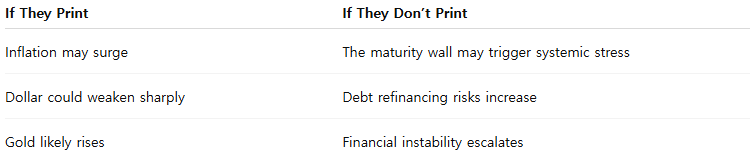
This resembles the Yellowstone wildfire analogy: suppressing small fires for years leads to the buildup of massive fuel. When ignition finally occurs, it becomes uncontrollable.
By preventing market corrections for years, policymakers may have amplified systemic fragility.
6️⃣ Gold’s Surge: A Signal of Trust Erosion?
Gold prices are climbing.
This may reflect declining international confidence in the U.S. financial system.
Gold benefits in both scenarios:
- If liquidity expands → currency devaluation → gold rises
- If financial stress increases → safe-haven demand → gold rises
Unlike Bitcoin, gold has historically maintained its safe-haven role during extreme systemic breakdowns.
7️⃣ 2026: Survival Over Returns
The central message is clear:
2026 may not be about maximizing returns.
It may be about surviving systemic transition.
The financial system appears to be in a critical state. Like a sandpile reaching instability, it doesn’t require a massive trigger—just a small disturbance.
A minor event in the repo market or shadow banking system could cascade through the leveraged structure.
This doesn’t guarantee collapse.
But it raises the probability of significant volatility.
📌 Final Thoughts
Why are US stocks and Bitcoin falling?
The underlying reasons may include:
- Persistent inflation limiting central bank flexibility
- Extreme leverage in Treasury and equity markets
- Shadow banking risks outside regulatory control
- A looming maturity rollover wall
- Liquidity contraction fears
For years, liquidity suppressed volatility and supported asset prices. Now the sustainability of that environment is being questioned.
Investors should consider not only potential gains—but structural risk exposure.