
Greenland-War in the Arctic Age Greenland-War in the Arctic Age
In covering the Greenland debate, one thing becomes clear: this isn’t just about territory or even rare earths.
Greenland sits at the intersection of Arctic shipping routes, missile defense (“Golden Dome”), subsea cables (communications + surveillance), energy security (oil/gas), and the broader U.S.–China–Russia power contest.
The story has moved beyond economics. Greenland is now treated as a national security asset.
1) Europe’s “deployment” scenario—and Trump’s tariff leverage
If European countries escalate by coordinating a joint security presence around Greenland, the pressure doesn’t stay military.
The most immediate lever is economic. Tariffs become a political weapon—especially against export-heavy European economies. In a prolonged standoff, the pain points would likely show up in sectors like pharmaceuticals, refining, autos, gas turbines, semiconductor equipment, and shipbuilding.
The deeper risk is political: this isn’t just a bilateral dispute. It can stress NATO cohesion, because Europe’s “we won’t yield territory” stance collides with a U.S. pressure campaign designed to force alignment.
2) “Golden Dome” and hypersonic threats: why Greenland matters to U.S. defense
Missile defense is where Greenland’s geography becomes more than a map detail.
In a forward-defense concept—often referenced as the “Golden Dome”—Greenland can function as a strategic node for detection, tracking, and early warning.
That matters more in an era of hypersonic missiles and Arctic-focused deterrence. Russia’s Arctic posture—nuclear submarines, long-range aviation, and next-generation missile capabilities—adds urgency.
From Washington’s viewpoint, Greenland isn’t optional if the Arctic is becoming a primary vector of strategic competition.
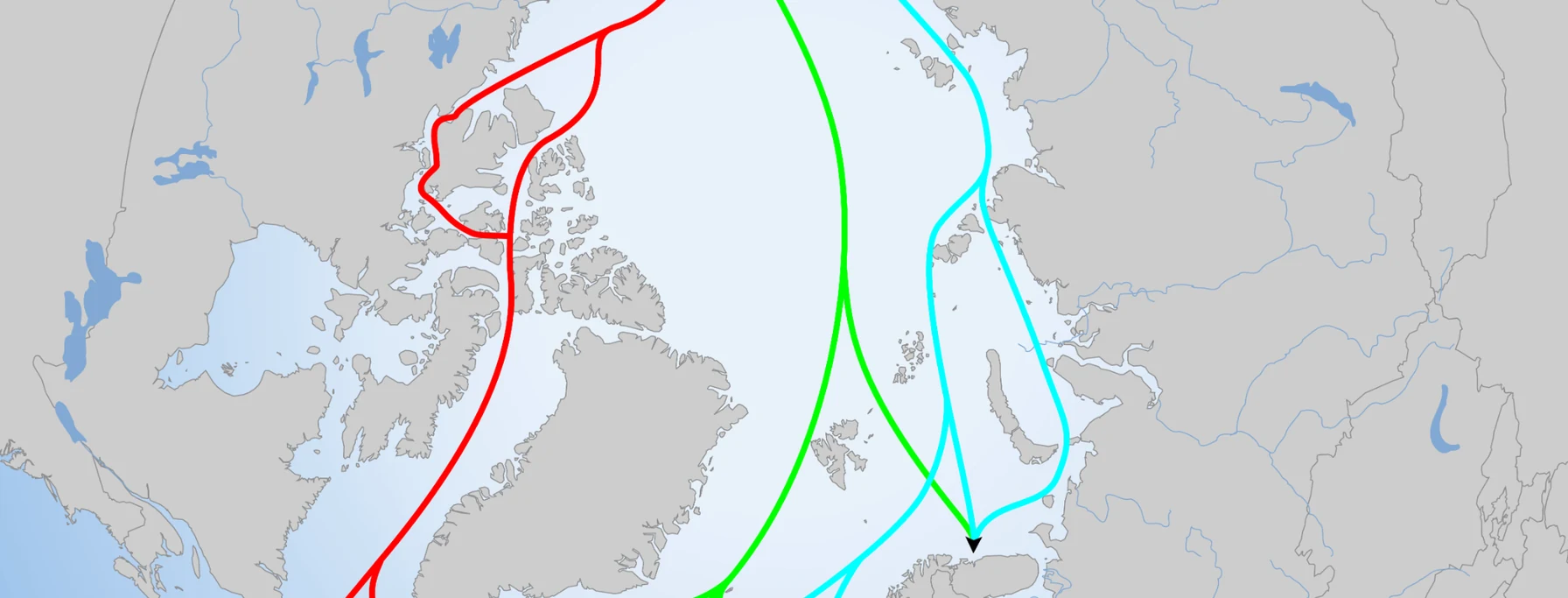
3) The Arctic route: time savings that translate into money and power
As ice recedes, Arctic sea lanes shift from theory to operational planning.
The headline benefit is simple: shorter Europe–Asia routes compared to Suez, which can compress shipping times and raise fleet efficiency—“one ship can do more rotations.” And whenever time and distance collapse, geography re-prices itself.
That’s why Greenland and Iceland gain significance: they sit near the routes and chokepoints that matter when the Arctic becomes a serious logistics corridor.
4) The key angle: subsea cables aren’t just communications—they’re surveillance
Most global data traffic runs undersea. If Arctic routes shorten and infrastructure investment follows, new cable projects become cheaper and faster to build. But the cable story isn’t only about bandwidth.
A growing security concern is that cables can double as monitoring systems—with sensors capable of detecting underwater activity such as submarines or fleet movement. Add to that the geopolitical noise:
Chinese firms’ involvement in cable projects, and the rising number of cable-cut incidents where China or Russia get mentioned as potential culprits.
In this frame, Greenland becomes a communications–surveillance–defense junction, not just a patch of ice.
5) Resources as security: rare earths + oil/gas in the AI era
Rare earths are often presented as an economic story, but the more realistic lens is security.
Even if Greenland’s mining costs are high, diversifying away from China’s dominance can justify the expense.
The same logic applies to oil and gas potential in the region, especially as energy strategy and strategic autonomy re-enter national agendas.
In the AI era—where chips, batteries, and defense systems are resource-intensive—raw materials stop being “commodities” and start behaving like strategic dependencies.
Why it matters
Greenland has become a 21st-century power infrastructure hub—where missile defense, Arctic logistics, subsea cable surveillance/communications, and strategic resources converge.
That’s why a fast, high-pressure approach—using tariffs and alliance leverage—can look “rational” inside the playbook driving this issue.