
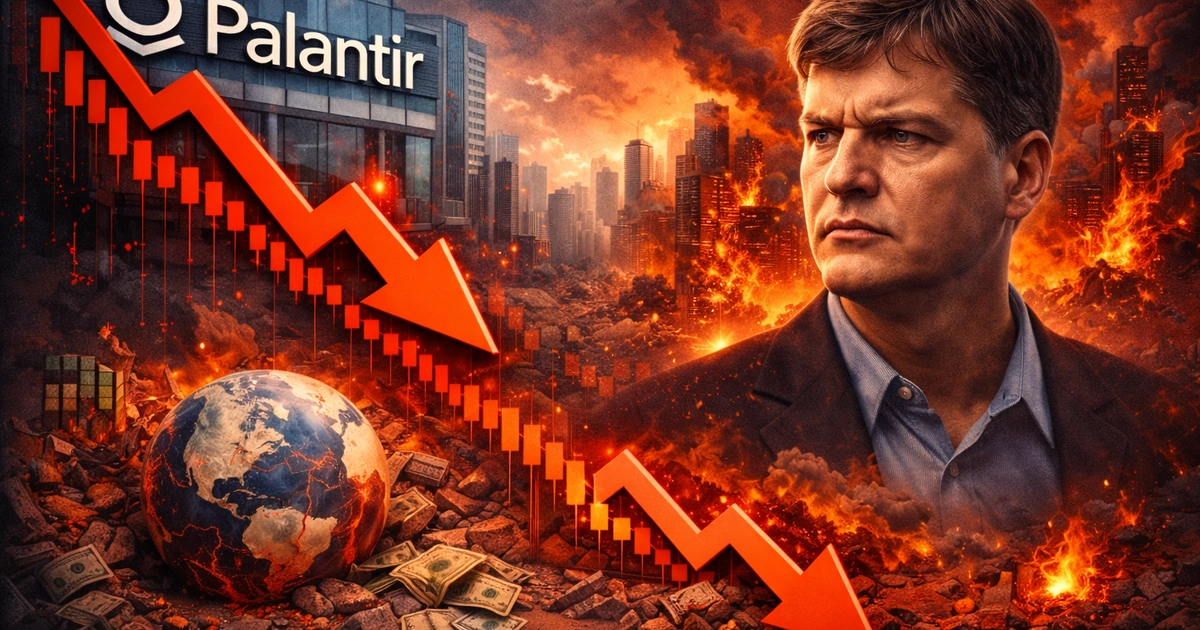
Michael Burry’s Criticism of Palantir Michael Burry’s Criticism of Palantir
📉 Palantir Stock Drops 5% After Michael Burry Calls It a “Well-Dressed Consulting Firm”
Palantir stock fell nearly 5% after sharp criticism from famed investor Michael Burry, best known as the real-life figure behind The Big Short. His remarks reignited debate over whether Palantir is truly an AI software powerhouse—or simply an overvalued consulting operation riding the AI hype cycle.
So what exactly did Burry say, and why did markets react so strongly?
🔍 Michael Burry’s Core Criticism of Palantir
1️⃣ “Not a Real Software Company”
Burry argued that Palantir resembles a personnel-heavy consulting business rather than a scalable software company.
Instead of selling plug-and-play SaaS products, Palantir:
- Deploys engineers to client sites long-term
- Customizes systems case by case
- Relies on human-intensive implementation
This structure, according to Burry, limits scalability and challenges the narrative that Palantir is a high-margin software platform.
2️⃣ AIP: AI Innovation or AI Layering?
Palantir’s recent rally has been driven largely by its Artificial Intelligence Platform (AIP). However, Burry offered a skeptical view.
He suggested that AIP is:
- Built on top of AI models developed by OpenAI, Google, and other Big Tech players
- More of an integration layer than a proprietary AI breakthrough
He also referenced research highlighting persistent issues in generative AI, such as hallucinations and logical inconsistencies. If Palantir relies on third-party AI infrastructure, it may lack the ability to fundamentally improve these limitations.
3️⃣ Financial Reporting Concerns
Burry questioned the company’s financial presentation, including:
- Treating engineer compensation as R&D rather than cost of revenue
- Highlighting profit metrics that exclude stock-based compensation
- Potential overstatement of operational profitability
Such accounting practices, he implied, may make margins appear stronger than they truly are.
4️⃣ Valuation Gap: Is $375 Billion Justified?
At the time of the remarks, Palantir’s valuation stood near $375 billion.
Burry estimated a fair value closer to $46 per share, suggesting a significant disconnect between market pricing and intrinsic value.
He also cited additional risk factors:
- Past promotional controversies
- Investment losses (including SPAC exposure)
- Intensifying competition from Microsoft and other tech giants
- Enterprises increasingly building in-house AI systems
Together, these elements could challenge Palantir’s long-term competitive advantage.
📊 Broader Market Impact
Following the comments, technology stocks—particularly software and semiconductor shares—faced renewed selling pressure.
The Nasdaq weakened, as:
- Elevated employment data keeps the Federal Reserve cautious
- High valuations in AI-related stocks face scrutiny
- Investors reassess growth expectations
Palantir’s drop may reflect not just company-specific concerns, but a broader re-evaluation of AI-driven equity premiums.
📌 Final Takeaway
Michael Burry’s critique forces investors to confront key questions:
- Is Palantir a scalable AI platform or a sophisticated consulting firm?
- Does AIP represent true technological differentiation?
- Are financial metrics overstating sustainable profitability?
- Is the current valuation pricing in unrealistic growth?
In a market driven by AI optimism, skepticism can quickly reshape sentiment. Whether this marks a temporary correction or a structural revaluation remains to be seen.