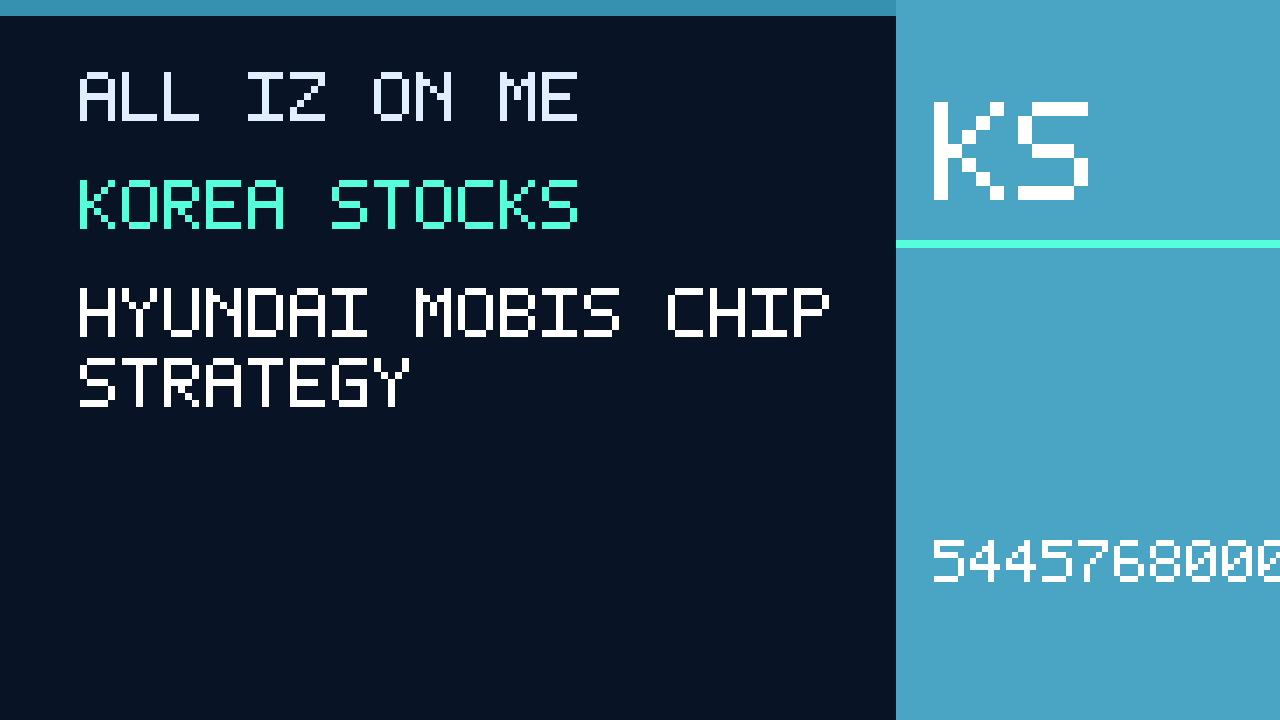
Hyundai Mobis: lamp sale, auto-chip expansion and half-year balance sheet Hyundai Mobis chip strategy
01. Medium- and long-term share-price direction
According to Korea Exchange daily data, Hyundai Mobis (012330) closed at 346,000 won on 2026-10-21. The consolidated balance-sheet figures are dated 2026.06.30: current liabilities were 15,669,565,000,000 KRW and total liabilities were 23,771,343,000,000 KRW. The price and financial figures refer to different dates.
In a 2026-10-08 report, Hana Securities kept its BUY rating on Hyundai Mobis. The same report referred to lowered earnings estimates and the value of affiliate stakes.
The medium- and long-term direction appears to depend on a recovery in core parts earnings and the pace at which new businesses become profitable. Lower estimates mean near-term earnings expectations have fallen, whereas a maintained BUY rating is different from a judgment that the long-term case has collapsed. Revaluation based on the chip strategy and affiliate stakes also needs support from operating profitability and cash generation.
02. Investment summary
The industry is focused on Hyundai Mobis moving beyond entering the auto-chip business toward a structure in which it develops car parts and chips together.
In its 2026-10-08 report, Hana Securities maintained BUY while lowering earnings estimates. A long-term chip in-sourcing strategy is therefore developing alongside an adjustment to near-term earnings expectations.
The investment appeal appears to lie in the possibility that joint parts-and-chip development improves costs, supply reliability and product differentiation. Conversely, development spending can arrive before mass-production revenue, delaying earnings improvements even if the strategic direction is sound. Operating profitability and the conversion of projects into production sales matter more than new-business announcements alone.
03. Recent share-price performance
Based on Korea Exchange daily price data, Hyundai Mobis (012330) closed at 346,000 won on 2026-10-21. This is that trading day's closing price, not the price on a later session.
This price appears useful as a reference point for assessing how expectations surrounding the lamp sale dispute and chip expansion enter the valuation. Short-term price moves should be considered alongside changes in earnings expectations, rather than treated as a verdict on the strategy. If enthusiasm for new businesses grows while earnings estimates keep falling, the gap between expectations and profits can widen.
04. Key drivers of share-price moves
Hyundai Mobis signed a definitive agreement to spin off its domestic lamp division and sell it, together with its overseas lamp division, to France's OP Mobility. The shareholder activism platform ACT and a group of Hyundai Mobis minority shareholders issued a statement opposing the sale.
The lamp sale appears to raise two linked questions: whether restructuring improves the business and how its benefits reach shareholders. Reallocating resources to profitable activities could be positive, while a prolonged dispute over terms and process could increase uncertainty. The announcement alone should therefore not be treated as an unqualified positive catalyst.
05. Earnings trends and profitability
In a 2026-10-08 report, Hana Securities kept its BUY rating and lowered its earnings estimates.
A 2026-10-22 Newsis article carried the view that companies with a high share of dollar revenue, such as Kia and Hyundai Mobis, could be affected by exchange-rate changes.
Profitability appears to warrant a conservative assessment. Dollar revenue can move reported won revenue, but the earnings effect also depends on the currencies of costs and settlement timing. With chip development spending under way, improving operating margins matters alongside sales growth. If margins fail to recover after the estimate cuts, growth expectations may provide less support for the valuation.
06. Core businesses and revenue sources
Hyundai Mobis is building in-house chip design capability to reduce its reliance on external suppliers for automotive chips. The industry notes that this gives the company a structure for developing parts and chips together. The company was also cited as one with a high share of dollar revenue.
Joint development appears to make chips not only a potential business in their own right but also a means of strengthening parts competitiveness. Linking design with parts development could improve access to suitable chips and reduce supply disruptions. Development and production costs can nevertheless arrive first, so higher revenue does not automatically produce higher earnings.
07. Growth and limitations of existing products
The industry is focused on Hyundai Mobis developing a structure that combines parts and chip development. This connects semiconductor development with the existing parts business.
The growth opportunity appears to lie in improving functionality and supply reliability so that existing products retain customer adoption. Chip in-sourcing could help, but design, certification and production require money and time. The relevant test is its contribution to sales and profitability of core products; an assessment of chip capability should not be extended into a judgment on the technology of the entire parts business.
08. New businesses and product pipeline
At the 2nd Auto Semicon Korea (ASK) 2026, hosted by Hyundai Mobis, the fabless company Global Technology described how it overcame four barriers to entering a new business: reliability certification, functional safety, quality and development systems, and business viability and standards. It credited close cooperation with Hyundai Mobis. The company CEO said it would use its first mass production as a springboard to broaden its product range.
According to a 2026-10-22 Newsis article, the partner described how cooperation with Hyundai Mobis helped it overcome entry barriers. The first-production achievement and product-expansion plans belong to that partner.
The partner's production experience appears to signal a broader chip supply ecosystem available to Hyundai Mobis. Joint work on certification and development systems can provide a foundation for subsequent products. A partner's expansion is not, however, the same event as higher Hyundai Mobis revenue or profit. Adoption in Mobis parts and rising production volumes will determine the investment payoff.
09. Overseas expansion and global competitiveness
Hyundai Mobis acquired the chip business of Hyundai Autron in 2020. The government and 24 companies and institutions, including Hyundai Motor, Hyundai Mobis and LG Electronics, launched a one-team task force to localize auto chips.
Partner Global Technology presented cooperation cases at Hyundai Mobis ASK 2026. The partner said it planned to use its first production as a springboard to expand into power, communications and display products.
Global competitiveness appears to depend less on localization alone than on meeting customer requirements for performance, quality, delivery and cost together. Supply reliability could help win overseas customers, but competing with established chip suppliers requires a production track record. Linking chips with parts becomes more valuable when it translates into overseas orders and profitability.
10. Business mix and revenue concentration
Hyundai Mobis is strengthening in-house chip design to reduce its reliance on external sourcing. As a company with a high share of dollar revenue, it was also noted to be exposed to currency effects.
This structure combines a supply-side chip procurement risk with a revenue-side exchange-rate sensitivity. Chip in-sourcing addresses the former; it does not eliminate earnings movements associated with dollar revenue.
Concentration risk appears best assessed separately across customers, products, currencies and suppliers. In-sourcing can reduce supply disruption while transferring more development and production responsibility to the company. The existence of currency and supply risks does not establish that they are larger than customer concentration risk. What matters is which exposure affects earnings and what practical response the company has available.
11. Broker recommendations and target prices
A Korea Economic Daily article dated 2026-10-01 covered a Hyundai Mobis target-price adjustment by Daishin Securities. The broker cut its target price from 690,000 KRW to 580,000 KRW, citing the lag before actuator mass production, and maintained its buy rating.
In a 2026-10-08 report, Hana Securities kept its BUY rating and lowered its earnings estimates.
The common thread appears to be continued investment appeal accompanied by lower near-term earnings expectations. Daishin's target adjustment specifically prices in the time needed to reach production. Rather than treating the gap between a target and a particular session's share price as assured upside, the key is whether production schedules and earnings forecasts change.
12. Earnings consensus and market expectations
In a 2026-10-08 report, Hana Securities lowered its earnings estimates for Hyundai Mobis.
A 2026-07-28 Asia Economy article headlined the view that Hyundai Mobis had factored in an electrification delay despite strong results.
The pattern appears to reflect a more conservative timetable for electrification and new-business earnings. Against lower expectations, faster monetization could become a positive surprise. Repeated delays could instead trigger further estimate cuts. Lower expectations alone are therefore not an investment case; the focus should be on whether results meet the revised earnings threshold.
13. Industry growth outlook
Seoul Economic Daily material dated 2026-10-22 on the auto-chip localization task force projected expansion in the global market toward 2030. The government and 24 companies and institutions are pursuing localization cooperation against this growth backdrop.
The expanding automotive chip market appears to explain the investment in in-house design and partner capabilities. Developing the chips needed for parts could improve supply reliability and product differentiation. Industry growth and company profitability are nevertheless different outcomes: orders must bring sufficient volume and pricing to recover development, certification and production costs.
14. Industry conditions and competitive dynamics
One assessment holds that Hyundai Mobis's auto-chip competitiveness is not yet outstanding. The company appears to have chosen to put long-term capability ahead of immediate results.
The industry is focused on Hyundai Mobis building a structure for developing parts and chips together. This business direction links parts development with semiconductor development.
Competition appears to extend beyond design performance into customer adoption and dependable production. Hyundai Mobis can connect parts development with chip design, but investment costs may affect earnings before this advantage is demonstrated. More customer adoption and stable production quality would improve the prospect of recovering development spending.
15. Regulation and policy changes
The government and 24 companies and institutions, including Hyundai Motor, Hyundai Mobis and LG Electronics, launched a one-team task force to localize automotive chips. This is a coordinated localization initiative involving companies and public institutions.
The initiative appears to provide a favorable setting for domestic suppliers to cooperate with customers and build certification and development experience. Participation alone does not guarantee a subsidy or purchase volume. Its investment significance for Hyundai Mobis lies in actual product adoption and supply-chain reliability rather than participation by itself.
16. Cost structure
Consolidated cash and cash equivalents as of 2026.06.30 were 5,445,768,000,000 KRW.
A 2026-10-23 BusinessWatch article reported the industry view focusing on Hyundai Mobis's joint parts-and-chip development structure.
Chip in-sourcing appears capable of improving procurement costs over time while increasing near-term design, verification and production-preparation spending. Cash holdings can support such upfront costs, but continuing to spend is different from earning an investment return. Better cost economics require revenue and profitability that recover development costs, not simply a broader in-sourcing program.
17. Recent major news
An OpenDART filing received on 2026-10-22 concerns a purchase of other securities from a related party, under receipt number 20261022000434. On the same day, ACT and the minority shareholder group issued a statement opposing the sale of the lamp division.
A 2026-10-22 Seoul Economic Daily article described Hyundai Mobis chip mass-production plans. These are production plans, rather than a statement that production revenue has already been earned.
The investment significance appears to center on capital allocation. The lamp sale concerns where the company retains resources; chip production concerns how those resources are connected with growth. A prolonged dispute over transaction terms and process could increase restructuring uncertainty. Conversely, production turning into revenue would make it easier to judge new-business expectations against earnings.
18. Positive and negative analyst views
In a 2026-10-08 report, Hana Securities kept its BUY rating while cutting estimates and referring to the value of affiliate stakes. According to a 2026-10-01 article, Daishin Securities cut its target price, citing the lag before actuator mass production, and kept its buy rating.
The positive case appears to be that long-term business and affiliate-stake value remain after a near-term earnings adjustment. The cautious case is that translating this value into earnings takes time. The key is not the number of buy ratings but delivery on production schedules and an end to downward earnings revisions. Meeting those conditions could strengthen the value case; delays could prolong the discount.
19. Financial health and cash holdings
As of 2026.06.30 on a consolidated basis, cash and cash equivalents were 5,445,768,000,000 KRW, current assets were 33,065,527,000,000 KRW, and current liabilities were 15,669,565,000,000 KRW. The bonds and long-term borrowings line was 1,035,743,000,000 KRW.
Total liabilities at the same date were 23,771,343,000,000 KRW. Cash and cash equivalents of 5,445,768,000,000 KRW are not the same metric as current assets of 33,065,527,000,000 KRW. The entire current-asset balance cannot be treated as immediately available cash.
Current assets exceeding current liabilities appears to be a positive indication for short-term payment capacity. Cash does not cover all current liabilities, however, making receivables collection and inventory conversion important. Cash exceeding the bonds and long-term borrowings line does not establish low total borrowing or that the entire cash balance is available for new investment. The balanced judgment is that current assets provide a buffer, while ample investment capacity requires a separate assessment.
20. Dividends, buybacks and shareholder returns
Consolidated cash and cash equivalents were 5,445,768,000,000 KRW as of 2026.06.30.
The sustainability of shareholder returns appears to depend on the balance between operating cash generation and investment, not cash holdings alone. Successful development and production investment can support future distributions; a delayed payoff can change allocation priorities even when cash is held. Cash should therefore not be treated as a promise of higher dividends or share cancellations. The appropriate focus is the balance between growth investment and returns to shareholders.
21. Future growth drivers
Partner Global Technology said it overcame entry barriers through cooperation with Hyundai Mobis. Its CEO said the company would use its first mass production as a springboard to expand into power, communications and display products.
Hyundai Mobis acquired the chip business of Hyundai Autron in 2020. This is part of the background to its development of chip capabilities alongside a partner ecosystem.
The combination of joint parts-and-chip development and partner product expansion appears to be the growth driver. More available products and development experience can broaden the choices for differentiating parts and meeting customer needs. Actual adoption volumes matter more than the pace of product-range expansion. Growth quality improves when revenue is sufficient to absorb development and production-preparation costs.
22. Share-price catalysts
According to a 2026-10-22 Yonhap Infomax article, Hyundai Mobis signed a definitive agreement to spin off its domestic lamp division and sell it together with the overseas lamp division to France OP Mobility. ACT and the minority shareholder group expressed opposition to the sale.
The catalyst appears to be execution on acceptable terms and the use of released resources, rather than signing alone. In chips, delivery on production schedules and conversion into sales could support expectations. Both become more meaningful when announcements turn into execution; prolonged opposition or production delays could weaken their effect.
23. Principal risks
As of 2026.06.30 on a consolidated basis, total liabilities were 23,771,343,000,000 KRW, current liabilities were 15,669,565,000,000 KRW, and cash and cash equivalents were 5,445,768,000,000 KRW.
The central risk appears to be delayed new-business revenue coinciding with continuing development spending. A longer wait for investment returns can reduce earnings visibility and funding flexibility together. Cash holdings do not eliminate risk: slower conversion of inventories and receivables, combined with higher investment, could increase funding pressure. Business execution and liquidity should therefore be assessed together.
24. Optimistic, base and pessimistic scenarios
In its 2026-10-08 report, Hana Securities maintained BUY on Hyundai Mobis while lowering earnings estimates. Near-term earnings expectations and the long-term investment assessment were being considered together.
The base case appears to assume that existing parts operations support development investment while new-business profits arrive gradually. The optimistic case assumes new-product production and customer adoption proceed as planned, lifting revenue and easing the burden of earlier development spending. The pessimistic case assumes delayed production leaves spending in place while revenue recovery slips. If implementation of the lamp sale plan described by Seoul Economic Daily on 2026-10-01 is also delayed, resource reallocation could take longer. The dividing factors are actual production timing, margins and cash conversion, not the number of announcements.
25. Short-, medium- and long-term strategies
Hyundai Mobis (012330) closed at 346,000 won on 2026-10-21. Hana Securities lowered its earnings estimates while maintaining BUY in its 2026-10-08 report.
A useful approach appears to focus on the pressure from earnings estimate cuts on price expectations in the short term, changes in margins in the medium term, and revenue and cash generation after development investment over the long term. Assessing profitability and funding needs in stages can make it easier to respond to delays than increasing exposure quickly on growth expectations alone. These are time horizons for testing an investment case, not a recommendation to trade at a specified price.
26. Suitable investor profiles
Hana Securities maintained BUY on Hyundai Mobis while lowering earnings estimates in its 2026-10-08 report. Consolidated cash and cash equivalents were 5,445,768,000,000 KRW as of 2026.06.30.
The stock appears better suited to investors able to tolerate timing delays and earnings volatility while waiting for production and profit contributions. It may be less suitable for those expecting an immediate earnings recovery or safety guaranteed by cash holdings. A long holding period does not remove risk; investors need to revise their judgment when the underlying business assumptions change.
27. Overall conclusion
The 2026-10-08 Hana Securities report maintained BUY and cut estimates. The industry is focused on Hyundai Mobis developing parts and chips together. Consolidated current liabilities were 15,669,565,000,000 KRW as of 2026.06.30.
Overall, this appears to be a period of waiting for joint parts-and-chip development to deliver while earnings expectations adjust. The investment case strengthens when production converts into sales and profitability improves; it weakens when development spending continues while production and cash recovery slip. Evaluating the long-term strategy also requires considering current liabilities and the cash generation needed to support investment.
28. Frequently asked questions
This appears consistent with a near-term liquidity buffer, not a guarantee of overall financial safety. Q: Is the balance sheet safe? A: Consolidated current assets of 33,065,527,000,000 KRW exceeded current liabilities of 15,669,565,000,000 KRW as of 2026.06.30. Cash was 5,445,768,000,000 KRW, which is not the entire current-asset balance. Q: What is the core of the chip strategy? A: The industry is focused on a structure that combines parts and chip development.
Delivery on production schedules and profitability appears decisive for the investment judgment. Q: What changes the investment case? A: New products converting into sales and profit after earnings estimate cuts would strengthen the long-term strategy. Conversely, rising development spending accompanied by delayed production and cash recovery would call for a lower assessment. Cash holdings or a buy rating alone do not remove risk.
Original sources
https://dart.fss.or.kr/dsaf001/main.do?rcpNo=20261022000434
https://dart.fss.or.kr/dsaf001/main.do?rcpNo=20260814004065
https://openapi.krx.co.kr/contents/OPP/USES/service/OPPUSES002_S2.cmd?BO_ID=JvJFzlAENzZlPBDNGAWC
https://file.hanaw.com/download/research/FileServer/WEB/industry/enterprise/2026/10/07/Mobis_261008_3Q26Preview.pdf
https://www.newsis.com/view/NISX20261021_0003835096
https://news.bizwatch.co.kr/article/industry/2026/10/22/0029
https://www.hankyung.com/article/2026100163116
https://www.sedaily.com/article/20104642
https://www.newsis.com/view/NISX20261022_0003836851
https://news.einfomax.co.kr/news/articleView.html?idxno=4440459
https://view.asiae.co.kr/article/2026072715472889010
https://www.sedaily.com/article/20096914