
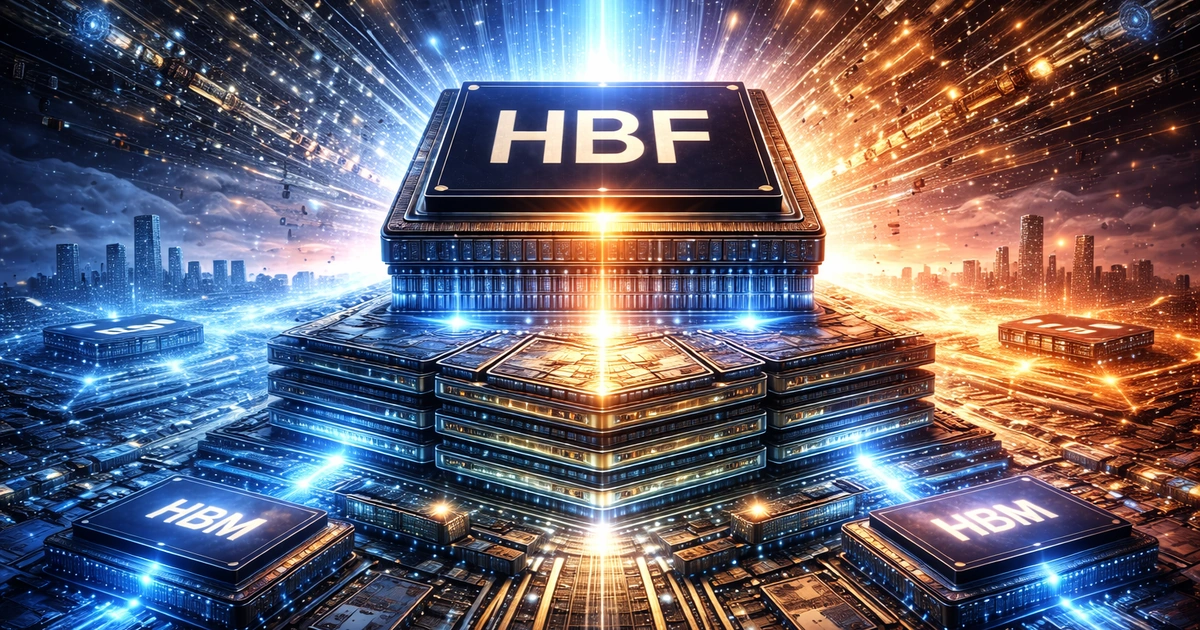
The era of HBF is coming The era of HBF is coming
🚀 Bigger Than HBM? The Secret Bet on HBF That Could Reshape AI Infrastructure
For the past few years, HBM (High Bandwidth Memory) has dominated discussions about AI semiconductors. But behind the scenes, a new architecture is quietly gaining momentum—HBF (High Bandwidth Flash).
If HBM revolutionized AI computation speed, HBF could revolutionize AI memory capacity.
And if successful, it may fundamentally change how AI servers are designed.
📌 What Is HBF (High Bandwidth Flash)?
HBF refers to stacking NAND flash memory—similar to how HBM stacks DRAM—and placing it physically close to the GPU.
Today’s structure looks like this:
- GPU connected directly to HBM (fast but limited capacity)
- SSDs connected externally via CPU and network paths (long and inefficient data routes)
HBF proposes a new structure:
- Large-capacity NAND stacked near the GPU package
- Data flows:
- HBF → HBM → GPU
- Or potentially GPU → HBF directly
In simple terms, HBF becomes AI’s massive long-term memory layer, sitting right next to the brain.
🧠 Why AI Needs HBF: The Data Explosion
AI models are rapidly demanding more memory due to:
- Real-time learning
- Massive retrieval tasks
- Personalized AI agents
- Continuous data updates
HBM is extremely fast but structurally limited in capacity expansion.
So the solution becomes hybrid:
- HBM: ultra-fast short-term memory
- HBF: high-capacity, slightly slower memory
This layered architecture mirrors how human memory works—fast recall and deep storage.
🏗 Is HBF Technically Feasible?
Yes—and faster than many expect.
The reason:
- TSV stacking technology already exists from HBM production
- NAND and DRAM are manufactured separately, then stacked during packaging
- Bonding and via technologies are shared
Samsung and SK Hynix already:
- Produce NAND flash
- Manufacture HBM
- Possess stacking expertise
Some companies (including SanDisk and SK Hynix) reportedly target 2027 commercialization, possibly as early as 2027–2028.
Engineering challenges remain (heat dissipation, power consumption), but development timelines are shorter due to reused HBM processes.
⚔ Big Tech Power Shift: GPU vs CPU Architecture
If HBF becomes standard, data center architecture could change significantly.
Currently:
- Data flows through CPU pathways
- GPU depends on CPU mediation
But with HBF integrated into GPU packaging:
- CPU dependency may shrink
- GPU-centric architecture strengthens
- AI accelerator makers gain greater influence
This isn’t just a technical change—it’s a hegemonic battle in AI infrastructure.
Historically, HBM adoption was first pushed by AMD (not NVIDIA). Disruptive memory innovation often begins with “hungry challengers.”
HBF may follow a similar path.
📈 Will AI Investment Continue?
Despite short-term volatility, the outlook suggests:
- AI infrastructure investment continues for 2–3 more years
- GPU demand remains strong
- Memory demand grows even faster
However, a larger question remains:
Can AI companies create enough value for users to justify high monthly costs?
For AI to sustain its massive infrastructure spending, it must become as essential as smartphones or cloud services.
If AI becomes economically indispensable, then:
- Memory demand explodes
- Semiconductor demand accelerates
- HBF gains structural relevance
🔮 The Future AI Memory Stack
If realized, future AI systems may look like:
- GPU → Compute Engine
- HBM → Ultra-fast cache
- HBF → Massive long-term storage
In this scenario, HBF doesn’t replace HBM.
It amplifies it.
And if AI models continue scaling, HBF may become the true capacity engine of the next AI cycle.